



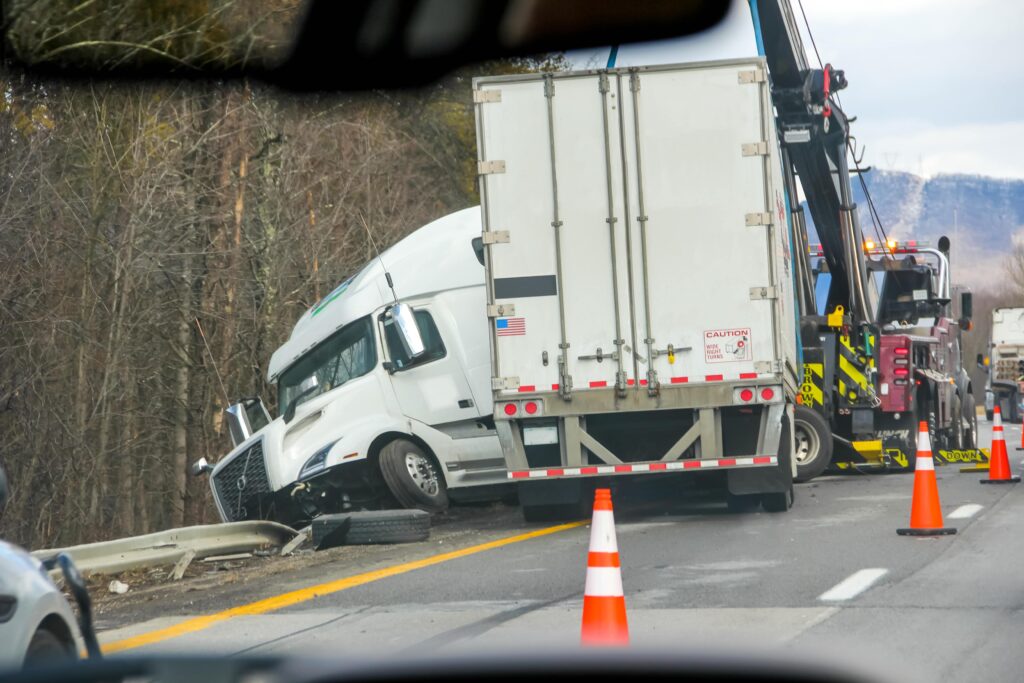
Commercial trucks are the backbone of New York’s economy. Every year, millions of tons of freight move through the City’s five boroughs, Long Island, and upstate industrial corridors. In New York City, nearly 90% of goods travel in and around by truck.
Tractor-trailers on the Thruway, delivery vans in Midtown, sanitation trucks in Brooklyn, and construction vehicles across Queens all share the road with ordinary drivers, cyclists, and pedestrians. And they all have one thing in common: When these large vehicles collide with a passenger vehicle, a cyclist, a pedestrian, or even another truck, they almost always come out on the “winning end” of the collision.
Truck accident cases demand a different level of investigation and a different legal strategy than a regular auto collision. Multiple corporate entities may be involved, critical data can disappear within days, and national carriers move fast to limit their exposure. You need to move fast as well if you want to preserve key evidence, create a strong claim, and come out on the “winning end” of your case.
You don’t need anyone to explain that a large truck is nothing like the vehicles around it. You can feel the difference when one passes: the air shifting, the low mechanical vibration moving through the pavement, the instant awareness that something massive and potentially unforgiving is close by. They’re larger, louder, and more imposing than anything else on the road.
You wonder whether the driver can even see you down there at the crosswalk or as you ease past them on the highway. You can’t help but be impressed by the size of these trucks. But you also feel something else: the unmistakable awareness of your own vulnerability.
That feeling doesn’t come only from the classic 18-wheeler barreling down I-87. New Yorkers share roads, bridges, and neighborhood blocks with every kind of large commercial vehicle:
Each one is built for a purpose. None is built with you in mind.
A fully loaded tractor-trailer can weigh up to 30 times more than an ordinary car. A garbage truck or cement mixer may move slower, but their massive bodies, limited visibility, and grinding mechanical components introduce dangers of their own. Even a midsized delivery truck can override the hood of a sedan in a single instant.
Being near a large truck is almost like being in the presence of a powerful animal. You feel its size. You sense the danger. You instinctively give it space because you know, on a gut level, that a close encounter could end badly.
But here’s the part that isn’t intuitive: Nothing about the way a truck accident claim works flows from instinct.
It doesn’t matter how the moment felt—it matters what you can prove, what evidence survives, and how quickly it’s preserved.
Every type of large truck traveling through New York carries its own risks. And because each operates differently, each creates a distinct pattern of fault, evidence, and potential defendants.
A tractor-trailer crash on the Thruway, a sanitation truck collision in a Westchester neighborhood, and a delivery van accident on a Midtown block may all fall under “truck accidents,” but the law behind each is something entirely different.
What unites them is this: the type of truck involved determines both who may be responsible and what evidence decides the case.
These are the giants of New York’s freight network. They’re governed by federal regulations and often tied to multiple corporate entities—one company owning the tractor, another owning the trailer, a third brokering the freight, and a fourth setting the driver’s schedule.
Who may be liable:
Evidence that matters:
Highway speeds mean high-energy impacts, which is why these cases so often involve catastrophic or fatal injuries.
Box trucks and rental vans appear everywhere in New York, from small towns to the Bronx, from Long Island strip malls to rural upstate hills. Many are driven by operators with little or no commercial training.
Who may be liable:
Evidence that matters:
Mechanical defects and negligent entrustment (renting a truck to someone unqualified) are common issues in these cases.
Last-mile delivery fleets dominate both suburban and urban corridors. Drivers face time pressure, forced routing from handheld devices, and dense neighborhoods where pedestrians, cyclists, and parked cars compete for space.
Who may be liable:
Evidence that matters:
Delivery cases can turn on whether the driver was truly an “independent contractor” or effectively supervised by a national brand.
These are among the most dangerous commercial vehicles in New York due to their operating conditions. A combination of dark, narrow streets, constant stopping and reversing, fatigued drivers, and blind spots can make for accidents waiting to happen.
Who may be liable:
Evidence that matters:
When a government-operated truck is involved, strict notice-of-claim deadlines apply—another reason why acting quickly is essential.
Construction trucks operate in constantly changing environments, carrying unstable or shifting loads that affect balance and stopping distance. These crashes often involve multiple companies working together on a project.
Who may be liable:
Evidence that matters:
Many of these cases hinge on whether the vehicle was overweight, improperly loaded, or negligently maintained.
Government-owned vehicles operate under distinct legal frameworks. Snowplows may be immune from liability unless operating recklessly. City agencies require a Notice of Claim within 90 days. Public utility trucks may be run by private contractors but under government direction.
Who may be liable:
Evidence that matters:
The legal thresholds are higher, but not insurmountable with the right evidence.
Large passenger carriers share many of the same risks as trucks: huge blind spots, long stopping distances, and enormous vehicle mass. They are also held to a heightened duty of care.
Who may be liable:
Evidence that matters:
Multiple injured passengers can mean multiple coordinated claims.
Hazmat carriers, tankers, and specialized heavy vehicles introduce risks and regulations unique to the cargo itself.
Who may be liable:
Evidence that matters:
These cases require expert witnesses familiar with industry-specific safety rules.
New York is not one driving environment. It’s dozens of them.
A tractor-trailer threading through Midtown behaves differently than a dump truck on a rural road outside Ithaca, and a sanitation truck navigating a Brooklyn brownstone block faces hazards completely different from a snowplow fighting whiteout conditions in the North Country. Geography shapes everything: how trucks move, what dangers they create, and what evidence matters after a crash.
Understanding where a truck accident happened is often the first clue in understanding why it happened—and who may be responsible.
Manhattan compresses every danger of urban trucking into the tightest space imaginable. Delivery vans, private waste haulers, box trucks, and construction vehicles share narrow lanes with cyclists, buses, and crowds of pedestrians. Many Manhattan crashes stem from the same patterns: unsafe backing into crosswalks, wide turns across bike lanes, midblock loading maneuvers, and blind-spot failures at crowded intersections.
Surveillance footage from storefronts, apartment buildings, and traffic cameras often becomes the most decisive evidence.
Brooklyn is a patchwork of industrial corridors, residential neighborhoods, and major arterial roads. Sanitation trucks and construction fleets dominate early mornings, while delivery vans weave through double-parked cars all day long. Narrow, one-way streets magnify blind-spot risks, and the BQE routinely produces multi-vehicle pileups involving box trucks and semis.
Cases here typically hinge on sightlines, illegal parking patterns, and traffic-flow disruptions unique to the borough.
Queens is shaped by logistics. With JFK and LaGuardia acting as international freight gateways, heavy tractor-trailer traffic moves constantly along the Van Wyck, Astoria Boulevard, and the LIE. Some of these drivers are fatigued, unfamiliar with local roads, or racing delivery schedules set in other states. Tight industrial corridors in neighborhoods like Maspeth and LIC create additional hazards.
Out-of-state carriers and interstate corporate defendants are common here, and so are black-box and telematics disputes.
The Bronx carries the weight of some of the worst freight bottlenecks in the country. The Cross Bronx Expressway’s mix of high speeds, sudden stops, aggressive merging, and lane-shifting under construction creates a perfect storm for underride crashes, jackknifes, and chain-reaction collisions. Residential blocks near industrial facilities add a second layer of risk from local fleet vehicles.
These cases frequently demand detailed accident reconstruction and deep dives into carrier safety records.
Staten Island sits at the doorway to New Jersey’s distribution hubs. Tractor-trailers pour in and out of the borough via the Goethals Bridge, while construction trucks and port-related vehicles move heavy loads through residential streets not built for commercial traffic.
When crashes occur in these tight neighborhoods, the key issues tend to be turning radiuses, lane encroachment, and oversize-vehicle routing.
Nassau and Suffolk see a different traffic mix: delivery vans, box trucks, landscaping fleets, oil delivery trucks, and tractor-trailers on the LIE. Suburban arterials create frequent left-turn and T-bone collisions; residential areas generate a high number of backing and driveway accidents. Farther east, winter weather and higher speeds contribute to severe tractor-trailer crashes involving jackknifes and rollovers.
Long Island crashes include factors like visibility at suburban intersections and the rapid loss of nearby surveillance footage from homes and businesses.
This corridor blends suburban density with rural stretches, meaning you see everything from local delivery trucks and municipal vehicles to long-haul semis on I-87, I-95, and the Tappan Zee/Governor Mario Cuomo Bridge. Poor lighting on rural roads, sharp curves, and speed differentials between small cars and heavy trucks all contribute to serious crashes.
When municipal vehicles are involved, strict notice-of-claim rules shape the early strategy.
Upstate and Western New York bring entirely different dangers: high-speed interstates, harsh winter storms, agricultural trucks, milk tankers, logging vehicles, and hazmat carriers. The Thruway, I-81, and I-90 routinely see jackknifes, rollovers, cargo spills, and chain-reaction crashes involving multiple semis.
Cases here may require weather data, road-treatment records, and advanced reconstruction to understand how the collision unfolded.
Where a truck accident occurs determines:
Where your crash happened can directly impact how it happened. Geography doesn’t just set the scene; it shapes the entire case.
Truck accidents aren’t ordinary accidents. They’re legal puzzles that must be assembled carefully, thoroughly, and professionally. If you want no loss to go unpaid, then you need no detail overlooked. That’s where choosing the right injury law firm makes all the difference.
Unlike a typical car accident, where the case is about you, the other driver, and one insurance company, truck cases can draw in multiple companies, contractors, and rules.
Depending on the type of commercial truck involved, you may face New York No-Fault rules, federal and state trucking regulations, and a liability chain that can include drivers, carriers, freight brokers, shippers, maintenance providers, or even municipal agencies
And with modern commercial fleets, critical evidence won’t wait. Black-box data can be overwritten. Delivery route logs can vanish. Surveillance footage may be deleted within days.
Early action is the difference between a strong case and a compromised one. We know exactly which records to secure, how to preserve evidence before it disappears, and how to prevent defendants from using the complexity of a truck case against you. A knowledgeable truck accident advocate is your best defense.
Many commercial trucks and drivers now use onboard systems that record speed, braking, hours, GPS routes, and other crash-reconstruction data. At Pain Injury Law, we match that technology with our own, streamlining communication, evidence collection, and claims processing to make your experience as painless as possible.
If you were injured in a crash involving a tractor-trailer, box truck, delivery van, garbage truck, construction vehicle, municipal truck, or any other commercial vehicle anywhere in New York, tell us how you were hurt, and we’ll tell you how we can help.
We represent clients across New York City, Long Island, Westchester, the Hudson Valley, the Capital Region, Central and Western NY, and upstate rural communities. There are no upfront fees, and you pay nothing unless we recover money.
Responde a unas sencillas preguntas para empezar.
Asignamos a tu reclamación un equipo de atención personalizada formado por un abogado, un asistente jurídico y un gestor de casos.
Consulta cuando te venga bien para ver cómo va tu caso. Envía mensajes a tu equipo asistencial y carga documentos directamente desde tu teléfono o elige otra forma de comunicarte y recibir actualizaciones.

Nuestra comunidad es la fuerza motriz de Pain Injury Law. Durante décadas, nuestros abogados y afiliados han servido de salvavidas a los neoyorquinos lesionados que luchan por superar las dificultades físicas, económicas y emocionales que conlleva lesionarse. Conoce al Equipo de Atención al Cliente que trabaja en tu caso.
Todos los correos electrónicos, el papeleo, las reuniones, las llamadas, las comparecencias ante el tribunal… todo es gratis a menos que ganemos tu caso de lesiones.
Todos los correos electrónicos, el papeleo, las reuniones, las llamadas, las comparecencias ante el tribunal… todo es gratis a menos que ganemos tu caso de lesiones.
Utilizamos cookies para personalizar el contenido y los anuncios, para proporcionar funciones de medios sociales y para analizar nuestro tráfico.
También compartimos información sobre tu uso de nuestro sitio con nuestros socios de medios sociales, publicidad y análisis, que pueden combinarla con otra información que les hayas proporcionado o que hayan recopilado de tu uso de sus servicios.
Leer más Política de privacidad Enlace
Botón : Permitir todo, Sólo lo necesario, Denegar todo